Neurographic Art: No painting experience required. Addictive, therapeutic & fun.
What if you made art without knowing what you were making?
Grab a black pen. Put it on the paper. Now draw a line. But here’s the catch.
Don’t let the line go where you think it should go.
Change direction. Cross another line. Head toward the edge. Turn unexpectedly. Make a mess.
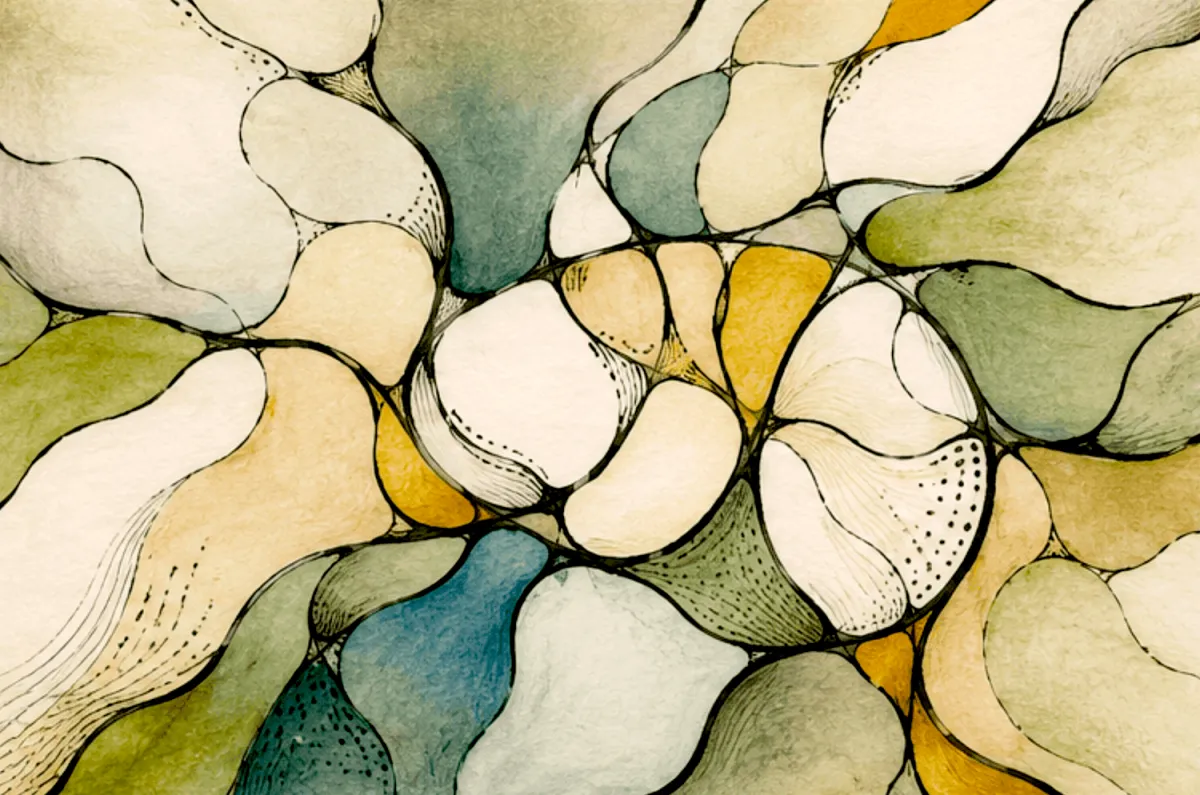
Good. You’ve started. Now comes the strangely satisfying part. Everywhere those lines collide, you’re going to soften the intersections.
Then you’ll start seeing shapes you didn’t deliberately create. You’ll add more lines and shapes. You’ll add colour.
And somewhere along the way, what began as a slightly chaotic tangle of lines starts looking as though it knew exactly what it was doing all along.
Welcome to Neurographic Art.
It’s part drawing exercise, part visual meditation, part creative experiment and, quite possibly, one of the easiest ways to lose an hour without noticing.
And no, you absolutely do not need to know how to draw. In fact, knowing exactly what you’re going to draw rather defeats the purpose.
What Is Neurographic Art?

At its simplest, Neurographic Art is an intuitive form of abstract drawing built from:
free-flowing lines
intersections
rounded connections
organic shapes
circles and other forms
colour
repetition
observation
Rather than starting with:
“Today I’m going to draw a tree.”
you begin with:
“Let’s see what happens.”
That creates a very different kind of art experience.
You’re not copying something.
You’re not trying to make the apple look convincingly apple-like.
You’re not worrying about perspective.
You’re responding.
One line creates another possibility.
One intersection creates a shape.
One shape suggests another.
Colour changes the balance.
You make a decision.
Then the drawing gives you something new to respond to.
It becomes a conversation between you and the page.
But Is Neurographic Art Actually New?
Not really.
And this is where the story gets much more interesting.
The contemporary name and style may feel new, but artists, educators and therapists have been experimenting with spontaneous lines, scribbles, automatic drawing, emerging forms and intuitive image-making for more than a century.
In other words:
The packaging may be newer. The creative DNA is not.
A Little Art History Detour
Don’t worry. There will not be a test.
But this part is fascinating.
Artists Were Letting Their Pens Wander 100 Years Ago
In the early twentieth century, artists began experimenting with ways of creating without completely controlling the outcome.
The Surrealists became particularly interested in automatism.
The idea was to loosen the grip of the rational, planning mind and see what might appear if the artist simply began.
Artists such as André Masson worked with automatic drawing in the 1920s, allowing lines to move across the paper without beginning with a predetermined subject or composition.
Shapes, figures and suggestions of imagery could emerge from the network of marks afterwards.
Even earlier, artists including Jean Arp experimented with automatic approaches to drawing.
So the idea that you can:
draw first and discover later
has a surprisingly long history.
Then Came the Scribble
Now we get even closer to what we recognize today.
Artist and educator Florence Cane became an important early figure in the development of therapeutic art practices.
Cane is credited with developing what became known as the scribble technique.
Instead of beginning with a recognizable subject, a person could begin with spontaneous movement and scribbled lines.
Then they could look at what appeared and begin developing imagery from it.
Her sister, Margaret Naumburg, became another influential early figure in American art therapy and explored spontaneous image-making as a way of accessing thoughts and feelings that could be difficult to express in words.
Artists and therapists were already discovering something important:
Sometimes you don’t need to know what you want to say before you begin making marks.
The marks themselves can give you somewhere to begin.
And Then Art Therapy Became a Field
People have used art for expression, ritual, storytelling, comfort and meaning-making for thousands of years.
But art therapy as a named professional field began developing much later.
British artist Adrian Hill is generally credited with introducing the term art therapy in 1942 after experiencing the value of art-making during illness and recovery.
Over the following decades, art therapy developed into a much larger professional discipline.
This matters because Neurographic Art did not suddenly appear from nowhere.
It sits within a much longer creative lineage:
automatic drawing
to
scribble drawing
to
expressive drawing
to
art therapy
to
intuitive and meditative art practices
to
contemporary Neurographic Art
These are different practices with different purposes and methods.
But one idea keeps appearing:
Let the hand move before the mind has everything figured out.
That idea is much older than social media.
Why Are We So Drawn to This Kind of Art?
Possibly because most of us spend an enormous amount of time doing exactly the opposite.
Planning.
Deciding.
Correcting.
Organizing.
Answering.
Comparing.
Finishing.
Optimizing.
Then someone hands you a pen and says:
“Draw a line and don’t worry where it’s going.”
Well.
That’s rather refreshing.
There is no bowl of fruit glaring at you because you somehow made the orange look square.
There is no reference photo to disappoint.
There is no correct outcome.
You simply have to begin.
Let’s Make One
Your Neurographic Art Activity
Give yourself about 30 to 60 minutes for your first drawing.
You can absolutely make a 15 or 20-minute version later.
For your first one, though, allow yourself enough time to experience the slower stages.
That’s where much of the pleasure is.
Materials
No giant shopping expedition required.
You probably already own everything you need.
You’ll need:
paper or a sketchbook
a black fineliner or marker
a second slightly thicker black pen, optional
coloured pencils, markers or paint
scrap paper for testing colours, optional
Mixed-media paper is lovely if you want to use watercolour or other wet media.
Otherwise, use whatever you have.
Seriously.
Printer paper and a black pen count.
Do not turn buying art supplies into Step 0.
We know how that story ends.
Three hours later you’re comparing twelve different black pens and still haven’t drawn a line.
Use the pen.
Step 1: Set an Intention
Before you start drawing, choose something to bring into your awareness.
Not your entire unresolved past.
We’re starting smaller.
Choose a word, feeling, question or idea.
Perhaps:
calm
clarity
confidence
energy
change
creativity
rest
freedom
curiosity
connection
play
Or maybe ask:
What do I need more of right now?
What am I curious about?
Where do I feel stuck?
What would happen if I stopped trying so hard?
Or use my personal favourite:
“Let’s see what happens.”
Your intention isn’t a magic spell.
You’re not commanding your subconscious to reveal the secrets of the universe before lunch.
You’re simply giving your attention a loose starting point.
Write your word on the back of the paper if you like.
Then turn the page over.
Step 2: Draw Your Lines

This looks ridiculously easy.
Until you try it.
Put your pen somewhere on the page.
Start drawing a line.
Let it wander.
Change direction.
Cross another area.
Turn unexpectedly.
Travel toward an edge.
Swing back.
Cross an existing line.
Now add another line.
And another.
Here’s the Trick
Your hand loves patterns.
Very quickly, it will start repeating a comfortable movement.
Perhaps the line starts turning into neat waves.
Lovely.
Predictable.
Decorative.
Also not terribly surprising.
When you notice yourself making the same movement again and again, interrupt it.
Change direction.
Make a larger movement.
Move into an empty space.
Cross the page.
Slow down.
Speed up.
Go somewhere your hand wasn’t planning to go.
You aren’t trying to create chaos.
You’re introducing unpredictability.
Let Some Lines Leave the Page
This is one of my favourite tricks.
Don’t neatly contain everything inside the paper.
Let a line wander right off the edge.
Let another enter from somewhere else.
Suddenly your drawing feels as though you’re only seeing one small section of something much larger.
Instant mystery.
Very little effort.
Excellent return on investment.
Step 3: Soften Your Intersections

Now we get to the part many people find oddly satisfying.
Find somewhere two lines cross.
You’ll see sharp little corners around the intersection.
Take your pen and begin rounding them.
Instead of two lines simply crashing into each other, you start creating a softer transition where they meet.
Go slowly.
Round one corner.
Then another.
Then another.
Continue through the drawing.
Sharp intersection.
Soft connection.
Sharp intersection.
Soft connection.
Eventually the drawing begins changing character.
The lines no longer look as though they simply collided.
They start belonging together.
What Does Rounding the Intersections Represent?
This is where the activity becomes more interesting than simply making an attractive pattern.
Think about a sharp intersection visually.
Two lines arrive.
They collide.
There is tension.
Then you round that meeting place.
You haven’t removed either line.
You haven’t erased the collision.
You haven’t pretended it didn’t happen.
You’ve simply changed the way the two things meet.
That creates a wonderful visual metaphor.
A sharp intersection might suggest:
friction
resistance
conflict
change
an obstacle
uncertainty
two things competing for space
Rounding might suggest:
adaptation
integration
softening
accommodation
connection
acceptance
finding another route
Does every intersection contain profound psychological meaning?
No.
Sometimes an intersection is simply two lines crossing.
And that’s perfectly fine.
But if a particular area makes you stop and think, stay there for a moment.
Art doesn’t always have to explain itself immediately.
One Idea Worth Keeping
You don’t always have to remove an uncomfortable intersection.
Sometimes you change the way you meet it.
That’s a much more useful idea than pretending life will eventually become a page with no crossed lines.
Step 4: Add Shapes, Details and Connections
Now stop drawing for a moment.
Really look.
Your wandering lines have accidentally created shapes.
Lots of them.
Some tiny.
Some enormous.
Some elegant.
Some slightly strange.
Good.
Strange is useful.
Ask yourself:
What’s already here?
Not:
What should I put here?
Those are very different questions.
Add Circles
Circles work beautifully in Neurographic Art.
Add one large circle.
Or several small ones.
Or a circle partly disappearing beyond the edge.
Let your existing lines travel through them.
You’ve just created more intersections.
Yes.
That means more rounding.
You knew what you were signing up for.
Add Another Line
Perhaps one area feels isolated.
Instead of decorating that little section, send another line travelling through the composition.
Let one change affect several areas.
That’s often more interesting than fixing tiny sections individually.
Find the Bigger Shapes
Squint slightly.
Can you see larger forms emerging from groups of smaller ones?
Perhaps several little shapes together create one sweeping movement.
Strengthen that.
Now you’re beginning to think compositionally.
Step 5: Add Colour
Now the dangerous part.
The art supplies come out.
Suddenly fourteen colours are looking at you saying:
Pick me.
Resist.
Start with three to five colours.
Try a Simple Colour Palette
Calm
sage green
soft blue
warm beige
ochre
Earthy
olive
terracotta
gold
deep brown
Fresh
turquoise
green
yellow
blue
Dramatic
deep blue
magenta
orange
gold
Or make your own.
Choose:
one colour you love
one colour that works beautifully with it
one colour that makes things slightly uncomfortable
That third colour is often where the fun begins.
Don’t Automatically Colour Every Little Shape
Your drawing has probably created dozens of enclosed areas.
The instinct is:
Excellent. Tiny colouring book.
And then every compartment gets a different colour.
You can do that.
But try something more interesting first.
Let colour cross the black lines.
Create one larger area of blue that travels through several shapes.
Let green appear in another section.
Repeat a little gold somewhere else.
Leave some white.
Suddenly you have two systems happening at once:
the black line system
and
the colour system
They don’t have to follow exactly the same boundaries.
That’s when things get interesting.
How Do You Know When It’s Finished?
Ah.
The eternal artist question.
Move it away from you.
Preferably before you’ve spent another forty minutes adding things nobody asked for.
Look from a distance.
Ask:
Where does my eye go first?
Does my eye travel around the drawing?
Is one area shouting while everything else whispers?
Does anything feel disconnected?
Is there enough quiet space?
Does it actually need another mark?
And then ask the dangerous question:
“Am I adding this because the drawing needs it, or because I’m nervous about stopping?”
There it is.
Sometimes the drawing is finished ten minutes before the artist is.
Neurographic Art Tips
In no particular order, because creativity doesn’t always behave well in numbered lists.
Rotate the Paper
Turn it sideways.
Turn it upside down.
Immediately you’ll notice things you couldn’t see before.
The brain becomes very attached to deciding which way is “correct.”
Do not encourage it.
Leave Some Empty Space
You don’t have to put something everywhere.
White space is doing something.
Let it work.
Vary Your Line Weight
Strengthen some lines.
Leave others delicate.
If every line has exactly the same visual importance, the drawing can become flat.
Variation creates hierarchy.
Don’t Round Everything Into Perfection
The drawing is made by a human hand.
Let it look that way.
Small irregularities are not failures.
They’re evidence that a person was here.
Try Working Bigger
A small sketchbook produces one kind of movement.
A large sheet of paper lets your whole arm become involved.
It creates a very different experience.
Try Working Very Small
A postcard-size version can be equally interesting.
Constraints change behaviour.
Don’t Force an Image
Eventually you may suddenly think:
That looks like a fish.
Or a face.
Or a flower.
Or an anatomical organ you’re fairly certain humans don’t actually have.
Fine.
Notice it.
You don’t have to turn the drawing into that thing.
Our brains are extremely good at finding recognizable images inside ambiguity.
Let yours play.
Now for the Brainy Bit
Does “Neuro” Mean Neurons?
Sort of.
The prefix neuro- relates broadly to nerves and the nervous system.
Neurons are specialized cells that transmit information within the nervous system.
And yes, the branching networks created in Neurographic Art can look remarkably neuron-like.
That’s probably part of why the word feels so appropriate.
But let’s not leap from:
“This looks a bit like a neural network.”
to:
“I have just drawn three new neural pathways beside the green circle.”
Science would like a word.
What Is Neuroplasticity?
Your brain is not a finished object.
It continues responding to experience.
Learning, practice and repeated activity can contribute to changes in how neural systems work and organize themselves.
This ability to change and adapt is broadly called neuroplasticity.
So yes, your brain changes through experience.
But that doesn’t mean:
one line on paper equals one new neural connection
or
rounding one intersection rewires one thought
Those can be interesting metaphors.
They are not established neurological equations.
We don’t need to exaggerate the science.
The real science is already interesting enough.
Your Brain Is Very Busy While You Draw
Drawing looks simple.
Hand.
Pen.
Paper.
Done.
Except your brain is coordinating an enormous amount of information.
You are:
looking
moving
judging distance
processing shape
making decisions
remembering what you just did
predicting where the line might go
comparing one area with another
adjusting your hand
responding to what appears
So while you think you’re doodling, your brain has rather a lot going on.
Does Making Art Reduce Stress?
This is where research becomes particularly interesting.
Studies of visual art-making have found changes associated with reduced stress, including lower cortisol levels after art-making sessions in some participants.
Researchers have also studied structured activities such as drawing, colouring and other forms of repetitive creative work and found reductions in anxiety or improvements in mood in some groups.
This doesn’t mean Neurographic Art has been proven to cure stress.
It does mean that there is credible research supporting something many artists already know from experience:
making art can change how you feel while you’re making it.
And importantly, you don’t need to be an accomplished artist to benefit from spending time making something.
Why Might Rounding Feel So Satisfying?
Here’s my non-magical theory.
You begin with visual tension.
Sharp intersections.
Unresolved crossings.
Then you perform a very simple task:
Find an intersection. Soften it.
Again.
And again.
And again.
Your attention has somewhere to go.
The task requires enough concentration to engage you, but not so much complexity that you’re solving advanced mathematics while holding a black marker.
You can see progress immediately.
Sharp becomes smooth.
Disconnected becomes connected.
Chaotic becomes more organized.
And humans rather enjoy watching disorder gradually become order.
No mystical explanation required.
Proven Benefits of Neurographic Art?
I prefer to change that question slightly.
What benefits can we talk about honestly?
There hasn’t been enough specific research on Neurographic Art itself to claim that this particular drawing method creates guaranteed neurological or medical effects.
What we can connect to broader research and creative practice includes the following.
Focused Attention
You repeatedly move your attention from line to intersection to shape to colour.
Instead of thinking about everything at once, you focus on what is directly in front of you.
Creative Problem-Solving
Every part of the drawing creates another decision.
Where should this line go?
What needs connecting?
What should remain empty?
Where should colour repeat?
You are constantly responding to small visual problems.
Lower-Pressure Creativity
There is no external subject you must reproduce correctly.
That removes one enormous source of creative anxiety:
“Mine doesn’t look like the picture.”
There is no picture.
Carry on.
Absorption
Repetitive creative activities can become immersive.
You may stop thinking about the finished result and become more involved in the process itself.
That can be deeply satisfying.
Stress Reduction Through Art-Making
Research into visual art-making has found reductions in some measures associated with stress and anxiety.
Again, that research applies to art-making more broadly, not specifically to Neurographic Art.
But it gives us a reasonable context for understanding why this kind of slow, focused activity may feel calming.
Visual Thinking
Drawing gives thoughts and relationships a visible form.
Sometimes you can see something on paper before you have words for it.
That doesn’t mean every mark contains a hidden message.
Sometimes simply seeing something outside your own head is useful enough.
Permission to Experiment
Perhaps this is my favourite benefit.
You don’t know what the finished drawing is supposed to look like.
So it’s very difficult to fail at making it look like itself.
A Very Important Note About Art Therapy
Neurographic Art can be relaxing, reflective and personally meaningful.
But making a drawing is not the same thing as receiving professional art therapy.
Art therapy is a mental-health profession practised by trained professionals.
Making art for relaxation, curiosity, personal reflection or creative exploration is wonderful.
We simply don’t need to call every meaningful creative experience therapy.
Sometimes making art can just be making art.
And that is already enormously valuable.
Try the 20-Minute Neurographic Art Reset
Don’t have an hour?
Excellent.
You have twenty minutes.
Minutes 1 to 2
Choose one word.
No essay.
Just one.
Minutes 3 to 5
Draw wandering lines.
Don’t plan.
Minutes 6 to 12
Round your intersections.
Slowly.
Minutes 13 to 15
Add a circle, shape or another line.
Minutes 16 to 20
Add two or three colours.
Stop.
Yes, actually stop.
Then Look
Before deciding whether it’s good, bad, brilliant or destined for the recycling bin, ask:
What do I notice?
Where does your eye go?
Which part feels calm?
Which part feels energetic?
Where did you slow down?
Where did you become impatient?
What colour did you reach for first?
What surprised you?
Did you become more focused?
Did time pass differently?
Did anything emerge that you weren’t expecting?
You don’t have to interpret everything.
Observation is enough.
Want to Make It More Interesting?
Once you’ve made the basic version, start experimenting.
Challenge 1: One Colour
Black plus one colour.
That’s it.
See how much you can do with very little.
Challenge 2: Three Colours
Choose:
one dominant colour
one supporting colour
one accent colour
Challenge 3: Giant Shapes
Begin with two or three enormous circles.
Then add your wandering lines.
Challenge 4: Almost Empty
Use only three or four lines.
Leave loads of space.
This one is surprisingly difficult.
Challenge 5: Take It Off the Page
Allow most of your major lines and forms to continue beyond the edges.
Notice how much larger the composition begins to feel.
Challenge 6: One Intention, Three Drawings
Use exactly the same intention three times.
Make three completely different drawings.
Now place them beside each other.
This is where things get really interesting.
You’re no longer making an isolated drawing.
You’re beginning a visual investigation.
The Secret Ingredient Isn’t Actually “Neuro”
This may be my favourite thing about the whole activity.
The word neurographic makes it sound wonderfully complicated.
Brains.
Neurons.
Connections.
Science.
Very impressive.
But the most useful part of the experience may actually be much simpler.
You begin without knowing.
You make a mark.
The mark creates a problem.
You respond.
Something unexpected appears.
You adjust.
You connect.
You simplify.
You add something.
You leave something alone.
You keep going.
Eventually, something begins to hold together.
That’s not only how drawings develop.
It’s how creative work develops.
It’s how paintings develop.
It’s how ideas develop.
And sometimes it’s how we develop.
Not because a black marker magically rewired our brain.
But because we were willing to begin before we knew exactly where we were going.
Your Turn
Get a piece of paper.
Find a black pen.
Choose one word.
Put the pen down.
Make the first line.
Don’t worry about where it’s going.
That’s the whole point.
Sometimes you don’t discover the next direction by thinking harder.
Sometimes you discover it by making the first mark.